reabc/Publishing Zines for Prisoners An Interview with Anthony Rayson/Publishing Zines for Prisoners An Interview with Anthony Rayson.pdf
Web PDF • Imposed PDF• Raw TXT (OCR)
![PUBLISHING ‘ZINES FO PRISOAERS AN INTERVIEW wiTH ANTHI]NY RAYSI]N](Publishing Zines for Prisoners An Interview with Anthony Rayson 1.png)




![satisfy. [Laughs) Sometimes its hard to put their stuff together because it’s such a mess; you do the best you can with it. Mainly 1 keep editing to a minimun. 1 keep what they want (o say and the way they want to say it. If they want to use ‘misspellings because that’ their way of talking, I let it slide and don’t change it to correct English unless it’s an obvious mistake they didn’t catch. T don’t re- strict them to: certain amount of words. I don’t tell them what o say. Let them say what they want, you know? Give ‘em that freedom. So some publications are not long. Some are insanely long. [Laughs] So you just go with what happens until we are both satisfied that it a complete project. ~ WEAPONS OF MASS DESTRUCTION dd (Hyung-Rac) Tarsell, 2002 18 Drawing by](Publishing Zines for Prisoners An Interview with Anthony Rayson 10.png)
![AR: 1t used as a way of supporting them politically. You can’t send them ‘money directly 50 you’ve got to put it on the books. You want to figure out how to give them money for their terrific artwork so you try to figure out a way to do that. ‘The more brilliant writers are pretty much locked down the most, and by that time their families abandon them. They have their own horrible problems. Tl do what T can for them, ‘TS:Are you able to visit many people at prisons or is everything mostly through the mail? AR: It is mostly through the mail. Ocassionally I’ll visit them ... Its so depress- ing when you do go. Its just disgusting. They (the guards] don’t give a damn; they just waste your time for two or three hours right off the bat, before you even geta chance to see anybody. And nowadays t’s so bad you can hardly even touch them or see them. Its just being Skyped in; they’re maybe ity yards away somewhere on a different Skype screen. So you Just se them on TV. Even my brother, who was in Will County Jail for a week for a DUI or something last month—I went to go visit him; it was Skyped. It makes It super easy on them. ‘They don’t have to do anything except bring him into this lttle room and they bring you into this litte room, and then there are all of these other people screaming. You can’t hardly hear ‘em. Ifs so impersonal. You can’t even touch ‘em or anything. Like we’e really going to slip them guns or whatever. So stu- pid. It’s just pure laziness and cost cutting. TS: When we were working with our collaborator Angelo on the project Pris- oners’ Inventions and 1 had tried unsuccessfully to visit him, T think his feeling ‘was that the quality of experience was probably superior just to write letters back and forth. He wouldn’t have to be strip searched to mail a letter like he would to receive a visit. AR: Some of these guys really suffer to meet just through Skype. They make them wear these hideous painful locks, totally shackled down while they’re ‘meeting their family through TV. Its just pure cruelty ... the only consolation is that the prisoner knows that you made this effort to do this. TS: Have you received feedback after the prisoners see their art or writing in print? AR: Almost invariably they are very happy with it and thankful about it. Oc- casionally a guy will be pissed because he’s one of those people you just can’t 17](Publishing Zines for Prisoners An Interview with Anthony Rayson 11.png)

![“Who cares, jus? long as they’re n Freets and sut Society, away fre you respect us ] and we’ll](Publishing Zines for Prisoners An Interview with Anthony Rayson 14.png)

![this. 1 did this the whole time I was at work. 1 worked in a tollbooth. It’s Justa brain dead job. I figured you’d use maybe 5% of your brain doing that job. I still had a lot of brainpower to use—I could write a ltter and still be busy with all these diots going through [the toll]. A letter might take me four hours to write, but I puta lotof thought into it and they got a ot from it. s important to build these personal relationships and personal letters are about the best way to do t. Also my handwriting’s so horrible they have trouble reading me. [Laughs] “Oh Anthony, it took me a week to read your letter. Please type it next time." [Laughter] “I’m tryin, man!” TS: Let’s talk about the artwork that is sent to you Is it a gift? AR: Its always a gift. 1 always say: “T’m paying for all of this. It would be nice if someone can help me with stamps or a money order, or send essays, artwork, poems, whatever” Sothey always do that. If have a problem in my family and someone gets sick and I mention it, the cards pour in and they’ll have everyone on the wing sign it and it meansa lot, you know? Because I dorit even get that from my own family—no one does. You need that when you are down like that. ‘They help me emotionally, psychologicall, a litle bit economically when they can—occasionally a prisoner will step up and I’l get a few hundred dollars here and there. And they’ll do it anonymously sometimes; theyll say, “Hey Anthony 15aw one of your ‘zines, here’s some artwork. Do what you want with it” I tell them right up front that everything’s anti-copyright. You’re not going to get any money from this and T don’t sell anything. I’m not trying to sell anything. Except ideas, and that’s not for sale. They’e free. TS: And cash doesn’t circulate in prison. AR: Wel it probably does to some extent but mostly the currency is stamps nowadays. It used o be cigarettes, but they’ve pretty much banned that. Its ‘zines probably too, to some extent. It’slittle packs of soup o coffee or what- ever they get. Some people sell their services; they’ll sew clothes. And they get fewer and fewer stamps. Some of them only get two stamps a month. It pitifl. Sometimes I send them stamps too, paper to write with, envelopes. For a while, when I was still working I was able to send certain prisoners stipends—money orders—to put on their books and supplement the starvation food they are given, so they could actually eat something. TS: This would be a donation into their inmate account that they could use in the commissary? 12](Publishing Zines for Prisoners An Interview with Anthony Rayson 16.png)

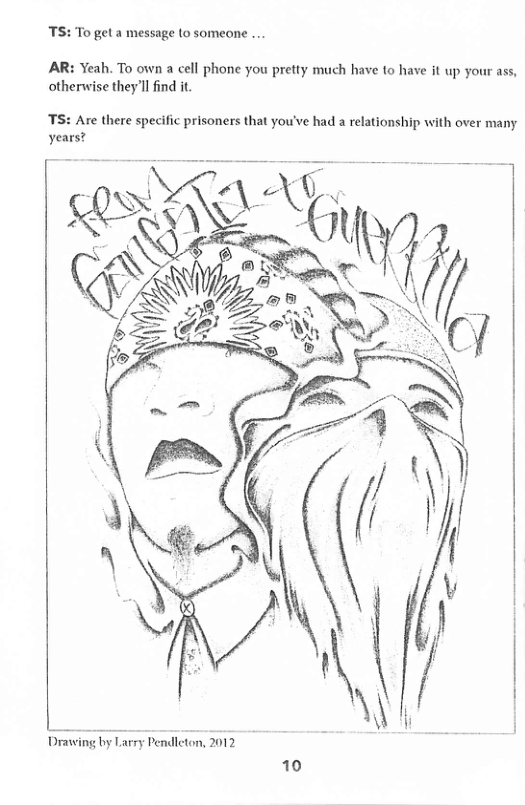
![that they’ll enjoy a much wider readership in prison? AR: It doesn’t really matter to me about who reads what of mine or whoever; I want to push the struggle forward. 1 want more and more people to get active and stop this government. That’s where I find the more fruitful collaborators, even though they are shackled and beat down and shoved in a cage. They still find ways of being effective. To this day it’s kind of surprising to me that these powerful ‘zines are let in as often as they are. Id say over 95% of them get in without being spit back for some stupid reason. Just recently I got a letter from Florida; they want to ban my catalog, in the whole state. And this s a listing of tiles. T wrote them back and said, “You mean to tell me that you guys are afraid of titles?” [Laughter] T guess sol In prison they have horrible ways they have to communicate and move things around. Its kind of sickening what they have to go through to com- ‘municate with the outside world or amongst themselves. They have to scream though toilets, or shove shit up their ass .. Drawing by Larey Pendleton, 2011](Publishing Zines for Prisoners An Interview with Anthony Rayson 19.png)
![letters a week on average, 99% of them from prison. Most of them want ‘zines, but some have contributions, essays, poetry, artwork, whatever, that they want me to help publish. So T have to make a determination about what I’m willing and able to do. 1 make a strong point to tell them that this isn’ a frivolous thing, we’re very serious about this, we want political analysis, this isn a game o us. As you can tell the artwork is very political, it’s not just joking around stuff, But we do have fun with it too. There are cartoon “zines, although they’re political too, and they’re banned as well. Guards don’ ike being made fun of. TS: Its nota lucrative economic opportunity for prisoners to make something, with you, but also they are personally at risk because of the content. AR: 1 tell them there’s no money in this. Everything is anti-copyright and the only person shelling out the dough will be me. 1 like contributions but I’m ot going to deny somebody because they are indigent and don’t have anything. But usually when they [the prison] find out what they [the prisoner con- tributors] are doing they get into nasty trouble because of it, They’ll go to the S.H.U. [Secure Housing Unit], they’ll send them to a more restrictive prison, they’ll assauit them, they’ll tear up their cell and take all of their personal pi tures to make them feel horrible for doing this. It takes a lot of courage to in- volve themselves because I’ll put their mailing address in the art so that other people can write to them and that’s how a lot f times other prisoners are able to contact them because they saw a ‘zine that they did. So they Il write (o someone they know and say ‘Hey, send this letter off to them; or to me, and that’s ho we’l try to break through the restrictions they have on us. TS: Prisoners generally cannot write letters to prisoners in other institutions. So they are using a friend or a family member on the out to other prisoners. e to help reach out AR: Yeah, any way they can. The zines themselves get passed all around there. ‘They “kite™ zines all through the prisons. They unravel these towels and they ‘make little clotheslines* and these “zines are read by countless people before they are destroyed by the guards. TS: Was that part of the impetus for trying to get more ‘Zines into prisoners— it is prison slang for a contraband letter, or a way of sending messages through the prison “ Clotheslines are used to pull 7ines or other objects down the cell block from one cell to another. 8](Publishing Zines for Prisoners An Interview with Anthony Rayson 20.png)
![— have to be the one to do it. So that’s how it [South Chicago ABC Distro] started. It started out as ARA Distro, but then I realized it was very limited and those publications were dated and who cares that you went and beat up a bunch of Nazis in Edmonton or wherever two years ago. So it started out as ARA, but then I started getting submissions from pris- oners about their work, and then there’s this guy named Sean Lambert who is a bisexual anarchist prisoner supporter out of the Buffalo, New York, area who ‘mentored me into this huge all new world of the prisons. He did these real in- depth prisoner support ’zines. So that’s where I irst switched my focus to the prisons and basically T’ve been there ever since. That was in the fall of 1995, Iwould glean through all o these prisoner support publications and I would send all this material for free to prisoners that were writing letters to them and Ivas starting to make catalogs of what I had. And then Id go to different confer- ences and youd table and youd see different publications you want to reprint and its just slowly built up (0 the point where its taken over this house. [Laughs] TS: Were prisoners getting your address from a resource list? AR: A resource list, but sometimes Id pay to have an advertisement in a ‘zine or a magazine or whalever, and just by the sheer energy of pouring it in and writ- ing catalogs and sending them in wherever I could, T slowly got more and more letters from prisoners; over the years they realized that I’m not just one of these fly by night guys that are going to be gone in two years. Then I started working with well-known political prisoners and doing interviews and publishing their ‘material as well so 1 got more respect up and down the line. Now I gt sbout 75 7](Publishing Zines for Prisoners An Interview with Anthony Rayson 21.png)


![actually address a rally.? For 38 years Rayson, who s now retired from his day job, worked as a toll collector. Hed fill the downtime in his booth writing letters to people in prison and working on ‘zines. A series of ‘zines that stands out within Rayson’s mas- sive body of work are his Each One Teach Onebooklets where Anthony and a prisoner that he corresponds with interview each other. In addition to South Chicago ABC Zine Distro, Anthony Rayson is also a co-founder and officer for Shut This Airport Nightmare Down (STAND), a 5,000 member grassroots group that consists of residents in Peotone linois who are “opposed to construction of, and land banking for, the proposed Peo- tone airport in eastern Will County, 45 miles south of Chicago”™ ‘We take particular interest in Rayson’s long relationship with people in pris- on whose ‘zines and artwork he has published, and who are the primary read- exship and audience for the booklets he makes. Rayson estimates that he gets about 75 letters from prisoners every week and usually sends out a couple zines in each package, sending out around 150 ‘zines a week. Incredibly, he does this for firee. Sometimes prisoners send him stamps, which they may barter with other prisoners to receive, or they’ll persuade their families or others on the outside to donate to Rayson, but most of the prisoners that write to him are indigent and have nothing to spare. Because Rayson mails zines to institutions all over the country, he has to keep track of the endless differences of what kind of content each institution will allow—sometimes testing the waters by sending out more mild materi- al before attempting radical publications. Zines can be rejected by the prison mailrooms for a huge list of reasons. Rayson states: Ttvaries, and it varies by the temperament of who’s on the clock at that time even. .. [1]t may depend on whether the person likes who its addressed 0. There’s no rhyme or reason. There’s no consistency. There’s no account- abiliy. .. Especially if its to the author himself or herself and they are talking about the prison. That i the one thing they can’t stand. They don’t want what is going on in that prison to get around. Rayson also regularly publishes ‘zines that are authored by prisoners who DePaul Librarian Michelle McCoy Interviews Anthony Rayson. South Chicago ARG Zine Distro, Homewood, 1L, 2008, Self-published as a booklet by Rayson. wiwnothirdairportorg, accessed August 27, 2014, *DePaul Librarian Michelle McCoy Interviews Anthony Rayson, South Chicago ABC Zine Distro, Homewool, 1L 2008, Self published as a booklet by Rayson. a](Publishing Zines for Prisoners An Interview with Anthony Rayson 24.png)
![PUBLISHING “ZINES FOR PRISONERS AN INTERVIEW WITH ANTHORY RAYSON Anthony Rayson heads South Chicago ABC Zine Distro.! He has been self-publishing for the better part of four decades. Now sixty years old, Rayson came to politics early in life as the son of Leland Rayson, a State Representative in Tllinois for twelve years, from 1965-77. As a child Rayson was always attend- ing demonstrations, rallies and other political events and would help with his father’s campaigns and events. During the Vietnam era, Rayson’s mother was part of Women for Peace. By the time he hit freshman year in high school, Rayson joined a campaign that his brother’s girlfriend was part of to push for women to be able to wear pants to school instead of only dresses and skirts. In freezing sub-zero Chicago winters, this is no small thing to have fought for. Anthony Rayson grew up in Tinley Park, llinois, and regularly traveled to Chicago for demonstrations. He would try to get his high school classmates to attend these events with him: ‘They had demos downtown—thered be a hundred thousand people at these demos. ... All the groups were out there. The Communists, the YSA, the [Young] Socialist Alliance, the [Black] Panthers would be hawking their paper .. It seemed like everyone had publications they were hawking and 14 always grab whatever I could find and I would always ry to go to the guys with the bullhorn and grab the bullhorn off them and get my little say because they would never allow a little kid that no one knew to ABC an acronym for Anarchist Black Cross Cover illustrations: Hon. Mark A. Reid Bey, 2008 (front); McKeehan, 2011 (back) 3](Publishing Zines for Prisoners An Interview with Anthony Rayson 25.png)
PUBLISHING ‘ZINES
FO PRISOAERS
AN INTERVIEW wiTH ANTHI]NY RAYSI]N
26
25
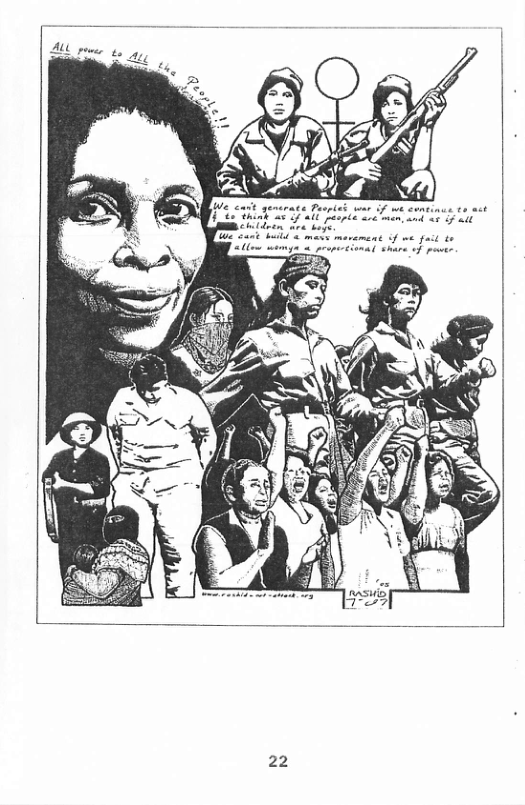
Every Afrikan womyn whe has
won the love of her people 3
for standing relentlessly 8§ Heseice
for their freedom against LD
ve system
been labeled [
by that system i |
ASSATA SHAKUR
Winnie Mandela
24
22
never be
easy for [ X
them to
destroy us”
21
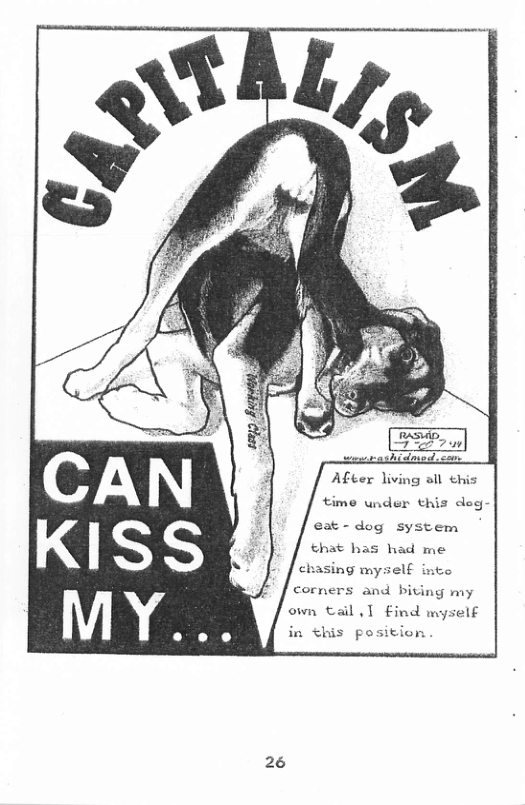
THE ART OF KEVIN ‘RASHID’ JOHNSON
Anthony Rayson has had a long relationship with Kevin ‘Rashid Johnson, a
prisoner who is currently incarcerated in Amarillo, Texas, after multiple trans-
fers. Johnson's stark drawings often feature intricate combinations of images
from various sources, remade as elaborate drawn collages. The works lend
themselves particularly well to Raysons favored black ink on white paper ap-
proach to publishing and Rashid’s work appears in numerous titles published
by Rayson over the years. Kevin ‘Rashid" Johnson is the Minister of Defense of
the New Afrikan Black Panther Party-Prison Chapler. You can see more of his
work on the website: www.rashidmod.com
20
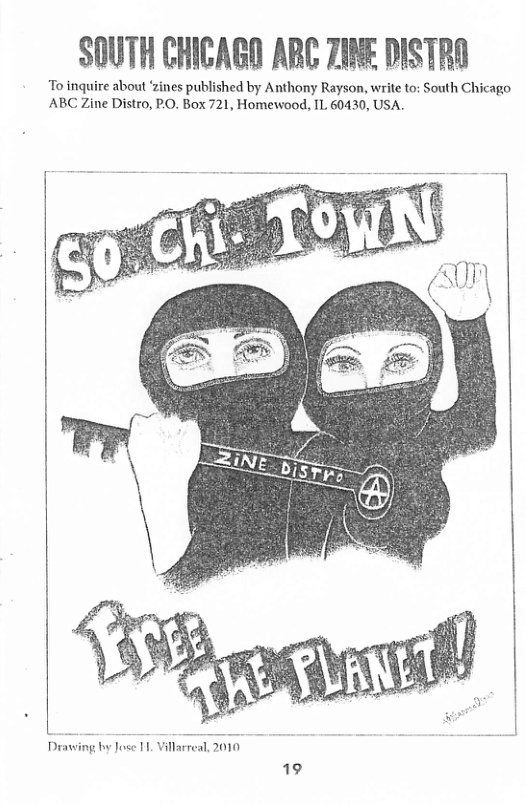
SOUTH CHICAGD ARC 7INE DISTRO
“To inquire about ‘Zines published by Anthony Rayson, write to: South Chicago
ABC Zine Distro, PO. Box 721, Homewood, IL 60430, USA.
satisfy. [Laughs) Sometimes its hard to put their stuff together because it's such
a mess; you do the best you can with it. Mainly 1 keep editing to a minimun. 1
keep what they want (o say and the way they want to say it. If they want to use
‘misspellings because that’ their way of talking, I let it slide and don't change
it to correct English unless it's an obvious mistake they didn't catch. T don't re-
strict them to: certain amount of words. I don't tell them what o say. Let them
say what they want, you know? Give ‘em that freedom. So some publications are
not long. Some are insanely long. [Laughs] So you just go with what happens
until we are both satisfied that it a complete project.
~ WEAPONS OF
MASS DESTRUCTION
dd (Hyung-Rac) Tarsell, 2002
18
Drawing by
AR: 1t used as a way of supporting them politically. You can't send them
‘money directly 50 you've got to put it on the books. You want to figure out how
to give them money for their terrific artwork so you try to figure out a way to
do that.
‘The more brilliant writers are pretty much locked down the most, and by
that time their families abandon them. They have their own horrible problems.
Tl do what T can for them,
‘TS:Are you able to visit many people at prisons or is everything mostly through
the mail?
AR: It is mostly through the mail. Ocassionally I'll visit them ... Its so depress-
ing when you do go. Its just disgusting. They (the guards] don't give a damn;
they just waste your time for two or three hours right off the bat, before you
even geta chance to see anybody. And nowadays t’s so bad you can hardly even
touch them or see them. Its just being Skyped in; they're maybe ity yards away
somewhere on a different Skype screen. So you Just se them on TV. Even my
brother, who was in Will County Jail for a week for a DUI or something last
month—I went to go visit him; it was Skyped. It makes It super easy on them.
‘They don't have to do anything except bring him into this lttle room and they
bring you into this litte room, and then there are all of these other people
screaming. You can't hardly hear ‘em. Ifs so impersonal. You can't even touch
‘em or anything. Like we'e really going to slip them guns or whatever. So stu-
pid. It's just pure laziness and cost cutting.
TS: When we were working with our collaborator Angelo on the project Pris-
oners’ Inventions and 1 had tried unsuccessfully to visit him, T think his feeling
‘was that the quality of experience was probably superior just to write letters
back and forth. He wouldn't have to be strip searched to mail a letter like he
would to receive a visit.
AR: Some of these guys really suffer to meet just through Skype. They make
them wear these hideous painful locks, totally shackled down while they're
‘meeting their family through TV. Its just pure cruelty ... the only consolation
is that the prisoner knows that you made this effort to do this.
TS: Have you received feedback after the prisoners see their art or writing in
print?
AR: Almost invariably they are very happy with it and thankful about it. Oc-
casionally a guy will be pissed because he's one of those people you just can't
17
Images: drawing by Chameleon, 2012 (previous page); drawing by J. Avzaham *
Garzanal, 2009 (sbove)
16
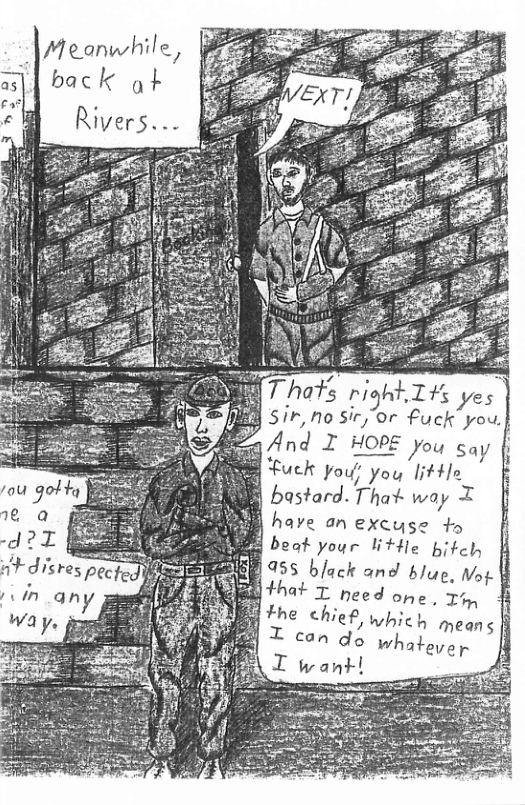
T hats right.I#5 yes
SiF, no sir, or fuckyou |
Fuck pou you litHle
bastard. That way T
have an excuse +,
beat your litde pitcl,
955 black and blue, Vop |
that T need ope, 74, 4
#he <hief, which meons
@n do whateyep
I want!
“Who cares, jus?
long as they're n
Freets and sut
Society, away fre
you respect us ]
and we'll
this. 1 did this the whole time I was at work. 1 worked in a tollbooth. It's Justa
brain dead job. I figured you'd use maybe 5% of your brain doing that job. I still
had a lot of brainpower to use—I could write a ltter and still be busy with all
these diots going through [the toll]. A letter might take me four hours to write,
but I puta lotof thought into it and they got a ot from it. s important to build
these personal relationships and personal letters are about the best way to do
t. Also my handwriting’s so horrible they have trouble reading me. [Laughs]
“Oh Anthony, it took me a week to read your letter. Please type it next time."
[Laughter] “I'm tryin, man!”
TS: Let’s talk about the artwork that is sent to you Is it a gift?
AR: Its always a gift. 1 always say: “T'm paying for all of this. It would be nice if
someone can help me with stamps or a money order, or send essays, artwork,
poems, whatever” Sothey always do that. If have a problem in my family and
someone gets sick and I mention it, the cards pour in and they'll have everyone
on the wing sign it and it meansa lot, you know? Because I dorit even get that
from my own family—no one does. You need that when you are down like that.
‘They help me emotionally, psychologicall, a litle bit economically when they
can—occasionally a prisoner will step up and I'l get a few hundred dollars here
and there. And they'll do it anonymously sometimes; theyll say, “Hey Anthony
15aw one of your ‘zines, here’s some artwork. Do what you want with it” I tell
them right up front that everything’s anti-copyright. You're not going to get
any money from this and T don't sell anything. I'm not trying to sell anything.
Except ideas, and that’s not for sale. They'e free.
TS: And cash doesn't circulate in prison.
AR: Wel it probably does to some extent but mostly the currency is stamps
nowadays. It used o be cigarettes, but they've pretty much banned that. Its
‘zines probably too, to some extent. It'slittle packs of soup o coffee or what-
ever they get. Some people sell their services; they'll sew clothes. And they get
fewer and fewer stamps. Some of them only get two stamps a month. It pitifl.
Sometimes I send them stamps too, paper to write with, envelopes. For a while,
when I was still working I was able to send certain prisoners stipends—money
orders—to put on their books and supplement the starvation food they are
given, so they could actually eat something.
TS: This would be a donation into their inmate account that they could use in
the commissary?
12
AR: I'm real close with some of them and it’s like a long lost brother when they
finally get out of prison.
TS: S0 you've had the opportunity to meet up with people you've corresponded
with?
AR: Oh yeah. I met this guy named Eugene Day. He was a three strikes” pris-
oner in California and 1 started publishing his stuff, and then he was able to
publish more stuff in more mainstream publications out in California. And
his writing, among other things, were able to soften some of those three strikes
laws to allow some of these guys to get out. I met him in Sacramento when I was
putting on an art show. He's doing great work now. He's got a prisoner support
thing going now that hes out and its just so great because he was doomed. He
was gonna be there the rest of his lfe. But he got out because we were able to
change the laws just enough to get him out and it was so overcrowded ... basi-
cally his third strike was a “nothing” offense
Tll go anywhere in the country and people will put me up. Its great. I like
to try to work with people that have no other support. I've worked with some
of these well-known political prisoners, but they already have support. It may
not be the greatest, but i’s better than nothing, which a lot of these guys do.
And just from the letters they write you can sort of tell if they're talented or
not—if they have a way with words or if they are artistically talented. And you
just encourage them and suggest to them that maybe we can work something
out together. And it's amazing, some of these guys are so beat down and down
on themselves because of their horrible situation and all of the misery that’s
thrown down on them. With a ltle bit of encouragement and human connec-
tivity ... Bam! They start soaring and doing incredible work and they turn into
incredible researchers or arists or organizers in prison, or prison lawyers of
whatever. It’slike a dying bird; you just nurse it back to health and it just fles
away.
TS: Do you provide editorial feedback on the writing?
AR: 1 do. 1 do a lot of handwritten letters in response to their letters, which
is very important to them because hardly anyone does it. Theres no real hu-
man-ness to it. Getting a ‘zine s cool and you can feel what the guy’ saying,
but it meansall the more to get a personalletter from someone that you hold in
high esteem, or you don't expect to get something, but you do anyway. Maybe
itll be one page, or several pages. 1 was lucky I had a good job to be able to do
Theee Strikes baves niaindate a sentence of a minimus
imprisonment for s felon convicted for the third
"
ol 25 years to a maximum of e
that they'll enjoy a much wider readership in prison?
AR: It doesn't really matter to me about who reads what of mine or whoever; I
want to push the struggle forward. 1 want more and more people to get active
and stop this government. That's where I find the more fruitful collaborators,
even though they are shackled and beat down and shoved in a cage. They still
find ways of being effective.
To this day it’s kind of surprising to me that these powerful ‘zines are let in
as often as they are. Id say over 95% of them get in without being spit back for
some stupid reason. Just recently I got a letter from Florida; they want to ban
my catalog, in the whole state. And this s a listing of tiles. T wrote them back
and said, “You mean to tell me that you guys are afraid of titles?” [Laughter] T
guess sol
In prison they have horrible ways they have to communicate and move
things around. Its kind of sickening what they have to go through to com-
‘municate with the outside world or amongst themselves. They have to scream
though toilets, or shove shit up their ass ..
Drawing by Larey Pendleton, 2011
letters a week on average, 99% of them from prison. Most of them want ‘zines,
but some have contributions, essays, poetry, artwork, whatever, that they want
me to help publish. So T have to make a determination about what I'm willing
and able to do.
1 make a strong point to tell them that this isn' a frivolous thing, we're very
serious about this, we want political analysis, this isn a game o us. As you
can tell the artwork is very political, it's not just joking around stuff, But we do
have fun with it too. There are cartoon “zines, although they're political too, and
they're banned as well. Guards don' ike being made fun of.
TS: Its nota lucrative economic opportunity for prisoners to make something,
with you, but also they are personally at risk because of the content.
AR: 1 tell them there's no money in this. Everything is anti-copyright and the
only person shelling out the dough will be me. 1 like contributions but I'm ot
going to deny somebody because they are indigent and don't have anything.
But usually when they [the prison] find out what they [the prisoner con-
tributors] are doing they get into nasty trouble because of it, They'll go to the
S.H.U. [Secure Housing Unit], they'll send them to a more restrictive prison,
they'll assauit them, they'll tear up their cell and take all of their personal pi
tures to make them feel horrible for doing this. It takes a lot of courage to in-
volve themselves because I'll put their mailing address in the art so that other
people can write to them and that's how a lot f times other prisoners are able to
contact them because they saw a ‘zine that they did. So they Il write (o someone
they know and say ‘Hey, send this letter off to them; or to me, and that’s ho
we'l try to break through the restrictions they have on us.
TS: Prisoners generally cannot write letters to prisoners in other institutions.
So they are using a friend or a family member on the out
to other prisoners.
e to help reach out
AR: Yeah, any way they can. The zines themselves get passed all around there.
‘They “kite™ zines all through the prisons. They unravel these towels and they
‘make little clotheslines* and these “zines are read by countless people before
they are destroyed by the guards.
TS: Was that part of the impetus for trying to get more ‘Zines into prisoners—
it is prison slang for a contraband letter, or a way of sending messages through
the prison
“ Clotheslines are used to pull 7ines or other objects down the cell block from one cell
to another.
8
—
have to be the one to do it. So that's how it [South Chicago ABC Distro] started.
It started out as ARA Distro, but then I realized it was very limited and those
publications were dated and who cares that you went and beat up a bunch of
Nazis in Edmonton or wherever two years ago.
So it started out as ARA, but then I started getting submissions from pris-
oners about their work, and then there’s this guy named Sean Lambert who is
a bisexual anarchist prisoner supporter out of the Buffalo, New York, area who
‘mentored me into this huge all new world of the prisons. He did these real in-
depth prisoner support 'zines. So that's where I irst switched my focus to the
prisons and basically T've been there ever since. That was in the fall of 1995,
Iwould glean through all o these prisoner support publications and I would
send all this material for free to prisoners that were writing letters to them and
Ivas starting to make catalogs of what I had. And then Id go to different confer-
ences and youd table and youd see different publications you want to reprint
and its just slowly built up (0 the point where its taken over this house. [Laughs]
TS: Were prisoners getting your address from a resource list?
AR: A resource list, but sometimes Id pay to have an advertisement in a ‘zine or
a magazine or whalever, and just by the sheer energy of pouring it in and writ-
ing catalogs and sending them in wherever I could, T slowly got more and more
letters from prisoners; over the years they realized that I'm not just one of these
fly by night guys that are going to be gone in two years. Then I started working
with well-known political prisoners and doing interviews and publishing their
‘material as well so 1 got more respect up and down the line. Now I gt sbout 75
7
“zines (mostly published by Rayson), a cluttered desk with no shortage of mail
and a compuler to answer it, drawers of audio cassettes and stacks of CDs, and
a box piled with a reassuringly large number of glue sticks. We left Rayson's
house with piles of Zines in hand—probably a year's worth of reading!
We were particularly interested in Rayson's large collection of artwork that
prisoners from all over the country have sent him over the years. He has boxes
of drawings, paintings and prints, many by the same artists that he has be-
friended and supported over the years—some already published in various
“zines, and others still waiting o find a use. Some pieces are signed but many
are not. Examples from his collection flow throughout this booklet
Given the hundreds of publications Anthony Rayson has made, distilling
his practice down into one booklet would be an absurd proposition. Still, we
felt that through our own publishing practice, which has rather different audi-
ence and tends to be experienced in an art context rather than largely through
the mail or in activist circles, we could amplify Rayson's example and highlight
the work of some of the talented incarcerated artists that have contributed to
his ‘zines over the years,
On September 22, 2014, Marc from Temporary Services returned to visit
Anthony Rayson with our collaborator Kristian Johansson. We scanned art-
work for this publication and conducted this interview. Anthony sent Kris-
tian home to Denmark with his own pile of ‘Zines. The interview took place in
Rayson's back yard.
TEMPORARY SERVICES (TS): Do you remember when you first started
getting mail from people who are incarcerated? When did that intersect with
your self-publishing?
ANTHONY RAYSON (AR): It was in the mid-1990s. I had just graduated
from Prairie State in 1995 and then I started writing a lot and really got into
the whole anarchist ‘zine underground thing, I was looking to collaborate with
other writers, basically, so 1 was sending my material to all different kinds of
people—inside and out—and gleaning all kinds of publications including let-
ters from prisoners or whoever, and it seemed more and more obvious to me
that the more in depth and insightful analysis of not only my work, but just
everything In general, was coming from the prisoners.
In '98 1 started the distro, 1 co-founded STAND, and 1 also co-founded
South Chicago ARA (Anti-Racist Action). So I went to an ARA conference in
Ohio and 1 saw these groups tabling from Canada or around the country and
they all had their own little publications and I went around and said, It would
be nice to have all of this available from one source” And they said “Yeah, thats
2 good idea” It became obvious to me that if it going to happen, I'm going to
6
send him their layouts for editing and design help, or simply to go straight to
publication.
In August 2014, Temporary Services and our collaborator Kione Kochi
drove down to Monee in South Chicago to visit Anthony Rayson at his home.
His office is the kind of space that any fellow publisher would be encrgized
by—a sunny room filled with bookshelves crammed with booklets, papers and
Drawing by Bran Scam, 2012
actually address a rally.?
For 38 years Rayson, who s now retired from his day job, worked as a toll
collector. Hed fill the downtime in his booth writing letters to people in prison
and working on ‘zines. A series of ‘zines that stands out within Rayson's mas-
sive body of work are his Each One Teach Onebooklets where Anthony and a
prisoner that he corresponds with interview each other.
In addition to South Chicago ABC Zine Distro, Anthony Rayson is also
a co-founder and officer for Shut This Airport Nightmare Down (STAND), a
5,000 member grassroots group that consists of residents in Peotone linois
who are “opposed to construction of, and land banking for, the proposed Peo-
tone airport in eastern Will County, 45 miles south of Chicago”™
‘We take particular interest in Rayson's long relationship with people in pris-
on whose ‘zines and artwork he has published, and who are the primary read-
exship and audience for the booklets he makes. Rayson estimates that he gets
about 75 letters from prisoners every week and usually sends out a couple zines
in each package, sending out around 150 ‘zines a week. Incredibly, he does this
for firee. Sometimes prisoners send him stamps, which they may barter with
other prisoners to receive, or they'll persuade their families or others on the
outside to donate to Rayson, but most of the prisoners that write to him are
indigent and have nothing to spare.
Because Rayson mails zines to institutions all over the country, he has to
keep track of the endless differences of what kind of content each institution
will allow—sometimes testing the waters by sending out more mild materi-
al before attempting radical publications. Zines can be rejected by the prison
mailrooms for a huge list of reasons. Rayson states:
Ttvaries, and it varies by the temperament of who's on the clock at that
time even. .. [1]t may depend on whether the person likes who its addressed
0. There’s no rhyme or reason. There's no consistency. There's no account-
abiliy. .. Especially if its to the author himself or herself and they are
talking about the prison. That i the one thing they can't stand. They don't
want what is going on in that prison to get around.
Rayson also regularly publishes ‘zines that are authored by prisoners who
DePaul Librarian Michelle McCoy Interviews Anthony Rayson. South Chicago ARG
Zine Distro, Homewood, 1L, 2008, Self-published as a booklet by Rayson.
wiwnothirdairportorg, accessed August 27, 2014,
*DePaul Librarian Michelle McCoy Interviews Anthony Rayson, South Chicago ABC
Zine Distro, Homewool, 1L 2008, Self published as a booklet by Rayson.
a
PUBLISHING “ZINES
FOR PRISONERS
AN INTERVIEW WITH ANTHORY RAYSON
Anthony Rayson heads South Chicago ABC Zine Distro.! He has been
self-publishing for the better part of four decades. Now sixty years old, Rayson
came to politics early in life as the son of Leland Rayson, a State Representative
in Tllinois for twelve years, from 1965-77. As a child Rayson was always attend-
ing demonstrations, rallies and other political events and would help with his
father's campaigns and events. During the Vietnam era, Rayson's mother was
part of Women for Peace. By the time he hit freshman year in high school,
Rayson joined a campaign that his brother’s girlfriend was part of to push for
women to be able to wear pants to school instead of only dresses and skirts. In
freezing sub-zero Chicago winters, this is no small thing to have fought for.
Anthony Rayson grew up in Tinley Park, llinois, and regularly traveled to
Chicago for demonstrations. He would try to get his high school classmates to
attend these events with him:
‘They had demos downtown—thered be a hundred thousand people at
these demos. ... All the groups were out there. The Communists, the YSA,
the [Young] Socialist Alliance, the [Black] Panthers would be hawking
their paper .. It seemed like everyone had publications they were hawking
and 14 always grab whatever I could find and I would always ry to go to
the guys with the bullhorn and grab the bullhorn off them and get my little
say because they would never allow a little kid that no one knew to
ABC
an acronym for Anarchist Black Cross
Cover illustrations: Hon. Mark A. Reid Bey, 2008 (front); McKeehan, 2011
(back)
3
@(‘4 oy M&v@\é{
TEMPORARY SERVICES
P.O.Box 121012
South Chicago ABG
5 Chicago, IL 60612
e%fll www.temporaryservices.org
March 2015